
FY1-7. Memorize key quotes / Preview / Reference materials

But these things are written so that you may believe that Jesus is the Christ, the Son of God, and that by believing you may have life in his name. (John 21:31)
For with you is the source of life; in your light we see light. (Psalm 36:9)
Preview of next lesson background: Luke 2:8-23 (see Matthew 2:1-15)
References
1. The Credibility of the Manuscripts of the Gospels
To determine the accuracy of a manuscript of a literary work, two factors must be considered. First, the number of extant manuscripts; second, the time gap between the original manuscript and the earliest copy. For example, only seven copies of Pliny's *Natural History*, written in the first century, survive, while the earliest copy appeared in the 8th century. Similarly, 643 ancient copies of Homer's *Iliad* exist, but the original manuscript is 400 years older than the earliest copy. In contrast, there are as many as 24,970 manuscripts of the New Testament. While scholars differ on the dates and order of the Gospels' writing, they generally agree that the Synoptic Gospels were written between 50 and 70 AD, and the Gospel of John between 80 and 90 AD. The earliest fragment of the Gospel of John we can find dates back to 125 AD, less than 50 years from the scholars' estimated date; a complete scroll is approximately 100 years old; and the earliest complete New Testament manuscript is no more than 250 years old. Therefore, the accuracy of the Bible manuscripts is beyond doubt.
II. Gospels outside the canon
Although many people have tried to record the life of Jesus, the basic requirement for a gospel is that it must have information provided by people who had personal contact with Jesus.
Another essential requirement for the Gospels is the testimony of early church leaders. In 155 AD, the writings of Justin, a martyr, already mentioned some apostolic memoirs (Justin, *Apologetics* 1.66). In 180 AD, the Church Father Irenaeus included most of the books of the New Testament, including the four Gospels, in his list of the Bible canon.
A popular novel claims that the Roman Emperor Constantine banned 80 gospels that did not call the Lord Jesus God, but the information is not accurate. By the beginning of the 4th century, there were about 60 books about the life of the Lord Jesus, most of which were written by heretical Gnostics (or pseudo-Gnostics). They borrowed the names of ancient figures and widely promoted their doctrines, believing that the Lord Jesus was God, but only a second-rate God without humanity; that is, the Lord Jesus never became flesh and was not crucified. The ancient authors of these works include Peter, Philip, Mary...
etc. There are also so-called "Gospel of Truth" or "Gospel of Savior", which are fabricated by others according to their own theories, borrowing the life of the Lord Jesus Christ. Borrowing the names of ancient figures is a common practice of the Jews. The so-called Apocrypha or Apocrypha of the Old Testament are all such works; none of them are regarded as canonical by the Jews.
In 2006, National Geographic announced that it had confirmed the authenticity of the "Gospel of Judas". It stated that a work found in a 66-page ancient book (codex, which is a bound manuscript close to the form of a modern book, different from the ancient scrolls that were popular earlier) was the only existing copy of the "Gospel of Judas". In fact, what National Geographic meant was that after various investigations, it was determined that the "Gospel of Judas" was a work from the third or fourth century, and its content was different from the Bible; it did not mean to prove that its content was consistent with the facts of the life of the Lord Jesus Christ. These works called gospels actually do not meet the basic conditions of gospels, and we must clearly distinguish them.
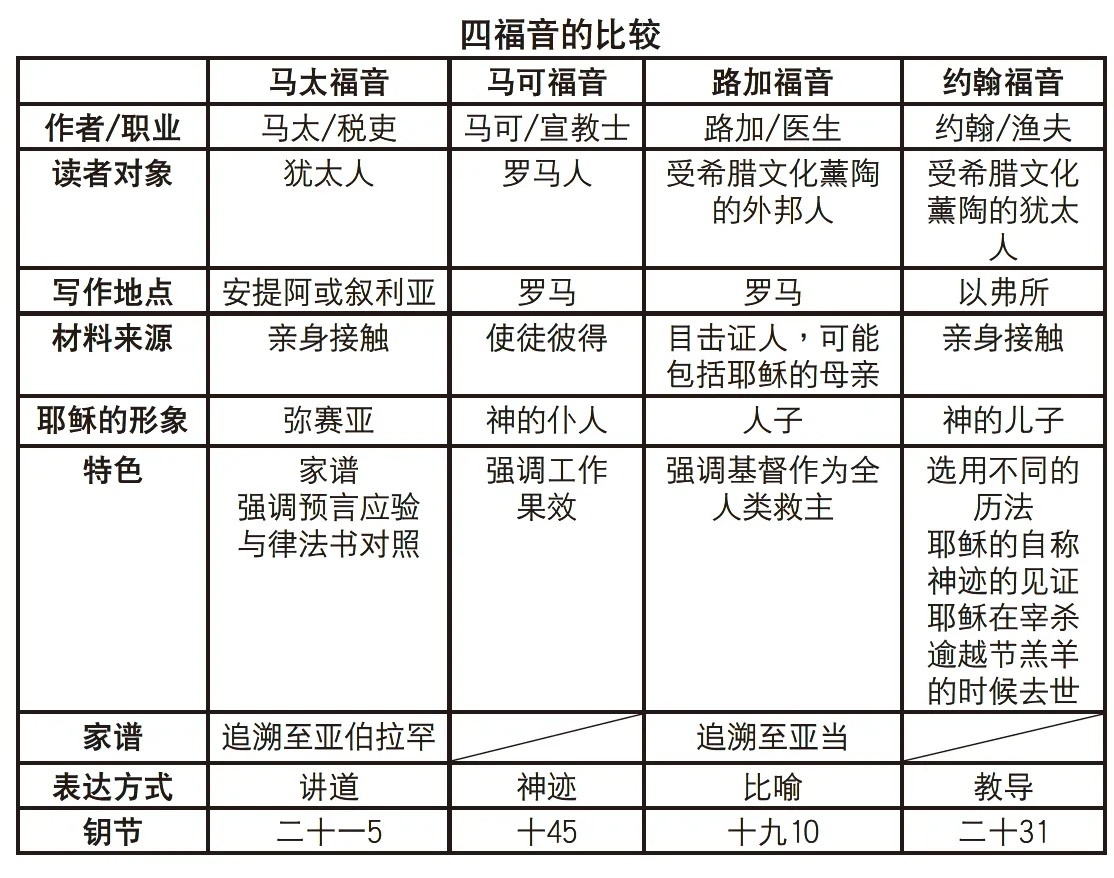
3. Comparison of the Four Gospels (see table below)
4. Tao
The word "Word" used by the apostle John is logos in the original language. He used this Greek word very appropriately. He transformed a popular Greek term at the time to represent "Christ". John pointed out that before all things, there was the Word. The Lord Jesus is the Word that existed in the beginning. He is the Word that was with God in the beginning. This Word is God. The beginning is the beginning of time before it began. It is the eternal eternity without a beginning. Our Lord Jesus was God in eternity before time began and before all things were created. The Lord Jesus that John spoke of (John 1:14) is a true portrayal of God. All things are established through Him. He is the creator of the universe.
Jewish theologians and Greek philosophers have different views on the "Word". In Greek philosophy, the "Word" is a principle of reasoning, or a thought that is still in the mind; therefore, for the Greeks, "the Word becoming flesh" is an incredible concept. The Jewish Old Testament points out that all things were created through the "Word" (see Psalm 33:6), the "Word" is the message conveyed to people through the prophets (see Hosea 1:2), and it is also God's law and His divine standard (see Psalm 119:11); for Jewish readers, God is unique, and "the Word is God" is a blasphemous statement about God; they regard the Word as a substance, and if they regard it as God, it is blasphemy. The Jesus that John talked about (John 1:14) is a true portrayal of God. All things are established through Him, and He is also the creator of the universe; for John, the new understanding of the "Word" is the gospel,
"The Word" is the truth, and "the Word" is Christ.
5. Light
Light in biblical history and theology is often associated with the removal of darkness. The contrast between light and darkness is a common theme in all words for "light" in the Old and New Testaments (especially the Hebrew or; the Greek phos). This word contains a contrast between good and evil, God and the forces of evil, believers and non-believers. The Bible does not have the idea that the forces of darkness are equal to the light of God. God is the absolute ruler, and He rules over the forces of darkness and evil.
God is Light
… John’s writings bring together the Old Testament’s understanding of light and present it as fulfilled in Jesus Christ (phos occurs 72 times in the New Testament, 33 of which are found in John’s writings). Light is the love of God revealed in Jesus Christ, which enters into lives darkened by sin (1 John 1:5-77). Jesus identifies Himself as “the light of the world” (John 8:12; 9:5). Jesus is the Word of God in flesh, who came into the world as a light for enlightenment (1 John 1:4-14), so that those who believe in Him no longer walk in darkness (12:46).
The light of salvation and life for believers
Those who respond to the light are ushered into the realm of life, and darkness is driven away. Salvation brings light to those in darkness (Job 20:28; Psalm 27:1; Isaiah 9:2; Matthew 4:15-16). Jesus Christ is the life-giving light, in Him there is life (John 1:4), and those who follow Him will never "walk in darkness, but will have the light of life" (John 8:12). Believers are "sons of light" (John 12:36; Ephesians 5:8; 1 Thessalonians 5:5).
Light has the power necessary for true life. Therefore, to be "in the light" means to be "alive," both eternal life and temporal life. Those who come into the light of Jesus Christ are brought into a life of moral enlightenment (compare Luke 16:8; John 3:19-21; 12:36).
The Light of the World
God is light, and He dispels the darkness of the world. Jesus came as the light of the world, breaking the darkness of sin through His work on the cross. Similarly, believers are the light of the world. Jesus described His disciples as light and messengers of light (Matthew 5:14-16). Paul told the believers in Asia Minor and Macedonia that their lives were a bright witness to the world they inhabited (Ephesians 5:8; Philippians 2:15). All believers have a responsibility to pass on the divine light they have received. They must openly and fearlessly proclaim what they have gained in the intimate fellowship of the believer community in the open (Matthew 10:27; Luke 12:3). (Excerpt from: Yang Qingqiu, ed., *Theological Dictionary of Witnessing the Lord* (Vol. 1), Evangelical Witness Association, 2001, pp. 363-364)