
Gospel 1-7. Memorize verses/Preview/Reference materials

但记这些事,要叫你们信耶稣是基督,是神的儿子,並且叫你们信了祂,就可以因祂的名得生命。(约二一31)
For with you is the source of life; in your light we see light. (Psalm 36:9)
Preview of next lesson background: Luke 2:8-23 (see Matthew 2:1-15)
References
1. The Credibility of the Manuscripts of the Gospels
要确定一个文学作品抄本的准确性,必须考虑两个因素。第一是现存抄本的数目;第二是原稿与最早抄本之间时间的距离。例如,第一世纪的罗马历史学家Pliny的《自然历史》一书,现存只有7个抄本,而最早的抄本在8世纪才出现;好像希腊诗人荷马的作品《Iliad》,现存有643个古抄本,而原稿与最早的抄本之间距离400年之久。相比之下,新约圣经的抄本有24970份之多。学者对福音书的成书日期与次序虽有不同的说法,但大致上都同意符类福音是在主后50-70年间写成,而约翰福音则是主后80-90年间成书。我们可以找到最早的约翰福音抄本碎片是主后125年的,距离学者所定的成书日期相差不足50年;一个完整的书卷抄本距离为100年;而最早的新约全书抄本不超过250年。可见圣经抄本的准确性是毋需置疑的。
II. Gospels outside the canon
Although many people have tried to record the life of Jesus, the basic requirement for a gospel is that it must have information provided by people who had personal contact with Jesus.
福音书的另一个基本条件是早期教会领袖的见证。在主后155年,殉道士游斯丁的著作中已提到一些使徒所著的回忆录(游斯丁《护教学》1.66)。主后180年,教父爱任纽写下的圣经正典名单中,大部份今日的新约书卷,包括四卷福音书均已在内。
A popular novel claims that the Roman Emperor Constantine banned 80 gospels that did not call the Lord Jesus God, but the information is not accurate. By the beginning of the 4th century, there were about 60 books about the life of the Lord Jesus, most of which were written by heretical Gnostics (or pseudo-Gnostics). They borrowed the names of ancient figures and widely promoted their doctrines, believing that the Lord Jesus was God, but only a second-rate God without humanity; that is, the Lord Jesus never became flesh and was not crucified. The ancient authors of these works include Peter, Philip, Mary...
etc. There are also so-called "Gospel of Truth" or "Gospel of Savior", which are fabricated by others according to their own theories, borrowing the life of the Lord Jesus Christ. Borrowing the names of ancient figures is a common practice of the Jews. The so-called Apocrypha or Apocrypha of the Old Testament are all such works; none of them are regarded as canonical by the Jews.
In 2006, National Geographic announced that it had confirmed the authenticity of the "Gospel of Judas". It stated that a work found in a 66-page ancient book (codex, which is a bound manuscript close to the form of a modern book, different from the ancient scrolls that were popular earlier) was the only existing copy of the "Gospel of Judas". In fact, what National Geographic meant was that after various investigations, it was determined that the "Gospel of Judas" was a work from the third or fourth century, and its content was different from the Bible; it did not mean to prove that its content was consistent with the facts of the life of the Lord Jesus Christ. These works called gospels actually do not meet the basic conditions of gospels, and we must clearly distinguish them.
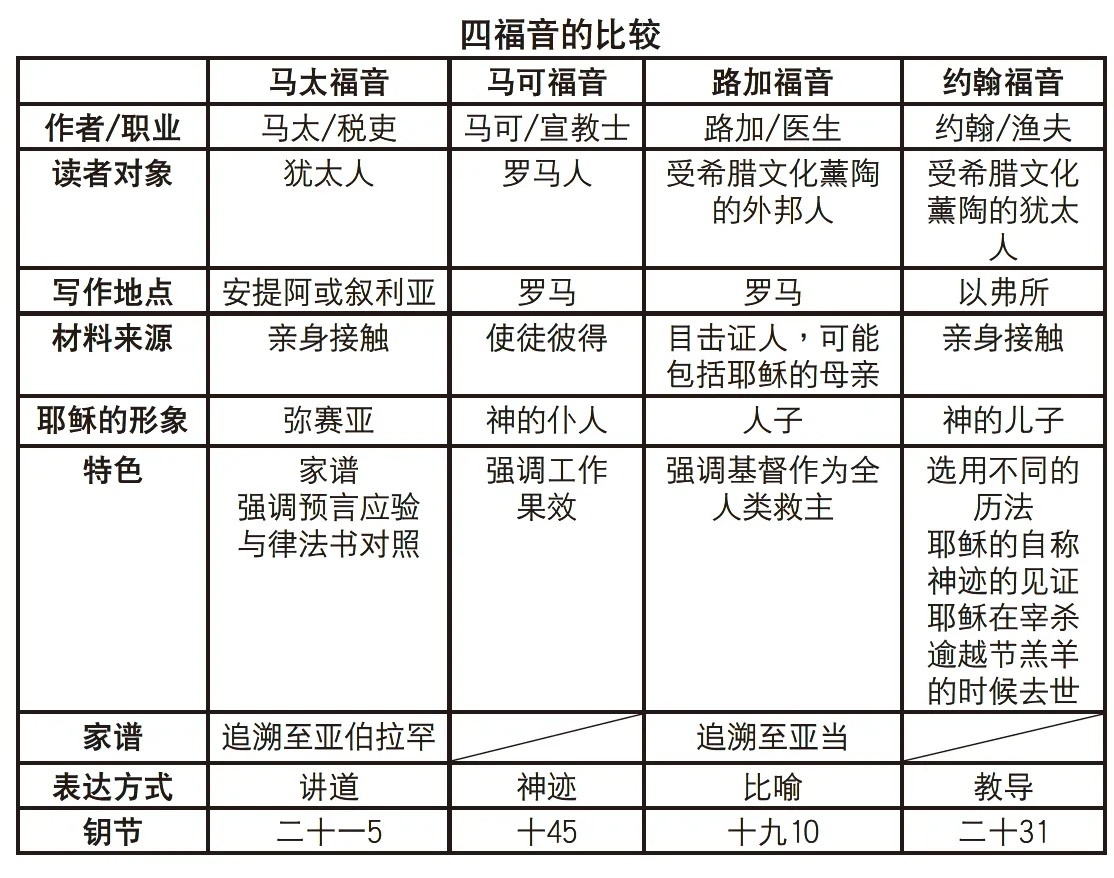
3. Comparison of the Four Gospels (see table below)
4. Tao
The word "Word" used by the apostle John is logos in the original language. He used this Greek word very appropriately. He transformed a popular Greek term at the time to represent "Christ". John pointed out that before all things, there was the Word. The Lord Jesus is the Word that existed in the beginning. He is the Word that was with God in the beginning. This Word is God. The beginning is the beginning of time before it began. It is the eternal eternity without a beginning. Our Lord Jesus was God in eternity before time began and before all things were created. The Lord Jesus that John spoke of (John 1:14) is a true portrayal of God. All things are established through Him. He is the creator of the universe.
Jewish theologians and Greek philosophers have different views on the "Word". In Greek philosophy, the "Word" is a principle of reasoning, or a thought that is still in the mind; therefore, for the Greeks, "the Word becoming flesh" is an incredible concept. The Jewish Old Testament points out that all things were created through the "Word" (see Psalm 33:6), the "Word" is the message conveyed to people through the prophets (see Hosea 1:2), and it is also God's law and His divine standard (see Psalm 119:11); for Jewish readers, God is unique, and "the Word is God" is a blasphemous statement about God; they regard the Word as a substance, and if they regard it as God, it is blasphemy. The Jesus that John talked about (John 1:14) is a true portrayal of God. All things are established through Him, and He is also the creator of the universe; for John, the new understanding of the "Word" is the gospel,
"The Word" is the truth, and "the Word" is Christ.
5. Light
Light in biblical history and theology is often associated with the removal of darkness. The contrast between light and darkness is a common theme in all words for "light" in the Old and New Testaments (especially the Hebrew or; the Greek phos). This word contains a contrast between good and evil, God and the forces of evil, believers and non-believers. The Bible does not have the idea that the forces of darkness are equal to the light of God. God is the absolute ruler, and He rules over the forces of darkness and evil.
God is Light
… John’s writings bring together the Old Testament’s understanding of light and present it as fulfilled in Jesus Christ (phos occurs 72 times in the New Testament, 33 of which are found in John’s writings). Light is the love of God revealed in Jesus Christ, which enters into lives darkened by sin (1 John 1:5-77). Jesus identifies Himself as “the light of the world” (John 8:12; 9:5). Jesus is the Word of God in flesh, who came into the world as a light for enlightenment (1 John 1:4-14), so that those who believe in Him no longer walk in darkness (12:46).
The light of salvation and life for believers
Those who respond to the light are ushered into the realm of life, and darkness is driven away. Salvation brings light to those in darkness (Job 20:28; Psalm 27:1; Isaiah 9:2; Matthew 4:15-16). Jesus Christ is the life-giving light, in Him there is life (John 1:4), and those who follow Him will never "walk in darkness, but will have the light of life" (John 8:12). Believers are "sons of light" (John 12:36; Ephesians 5:8; 1 Thessalonians 5:5).
Light has the power necessary for true life. Therefore, to be "in the light" means to be "alive," both eternal life and temporal life. Those who come into the light of Jesus Christ are brought into a life of moral enlightenment (compare Luke 16:8; John 3:19-21; 12:36).
The Light of the World
神是光,祂驱散这世界的黑暗。耶稣以世界的光来到,透过祂在十字架上的工作,打破了罪恶的黑暗。这样,信徒亦是这世界的光。耶稣形容祂的门徒为光及光明的使者(太五14-16)。保罗对小亞细亞及马其顿的信徒说,他们的生命对他们所处的世界是明光见证(弗五8;腓二15。所有信徒都有责任去将他们获得的神圣之光传递出去。他们要把在信徒群体的亲密相交中所获得的东西,公开地、无惧地在“明处”宣告出来(太十27;路十二3)。(节自:杨庆球主编《证主圣经神学辞典》(上),福音证主协会,2001年,363-364页)